
AI Eye Contact Correctionfor Adobe Premiere Pro
Make every speaker look directly at the camera — even when they were reading a script.
- AI gaze correction frame-by-frame, applied to your selected Premiere Pro clip
- Subtle by design — viewers see natural direct eye contact, not artificial alteration
- Works on talking-head, interview, podcast, and course footage
- Corrected clip drops back into your sequence — original preserved
- Powered by NVIDIA Maxine — the AI behind NVIDIA Broadcast
Free to try — no credit card required.
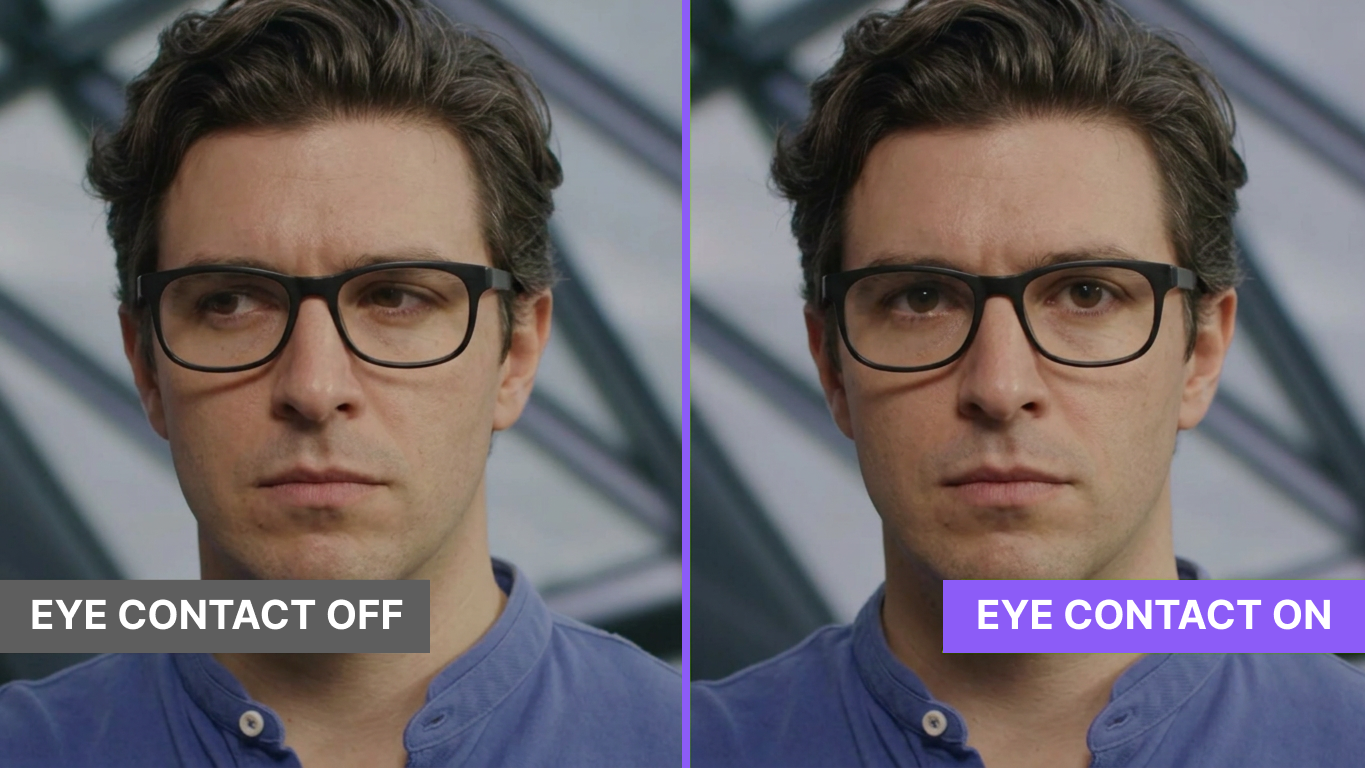
Direct eye contact is one of the biggest signals of speaker authority on camera
Most creators recording at home read from a script, glance at a second monitor, or sit slightly off-axis from the camera. The gaze ends up 5–15 degrees off-center — subtle enough that you don't consciously notice, significant enough that viewers feel less connection with the speaker. It's the difference between a speaker who's talking to the viewer and one who's talking near them.
AI eye contact correction — also called AI gaze correction — fixes that in post. Select the clip in Premiere Pro, hit Correct, and a corrected version drops back into your sequence with the speaker looking directly at the lens. Most off-axis source footage (5–15° off-camera) comes back reading as natural direct eye contact; extreme angles, heavy glasses glare, or partial face occlusion can occasionally produce visible artefacts, in which case the corrected clip lands on a new track so you can revert with one click.
What it fixes
Off-axis gaze
Script reading, second-monitor glances, teleprompter misalignment
Where it works
Any clip
Talking-head, interview, podcast, course footage in Premiere Pro
Processing time
~8–10× clip length
AI gaze correction is compute-heavy — runs in the background, chimes when ready so you can keep editing
How AI eye contact correction works
Select your clip
Highlight the talking-head or interview clip in your Premiere Pro sequence. CaptionX picks up the selection from the panel.
Hit Correct
One click sends the clip to the AI eye contact correction model. CaptionX runs in the background — keep editing the rest of your timeline.
AI redirects the gaze
NVIDIA Maxine analyses every frame and subtly redirects the speaker's gaze toward the lens. The result is natural direct eye contact, not artificial alteration.
Corrected clip lands above the source
When processing finishes, the corrected clip is placed on the V-track above your source. Your original is preserved — accept the correction, or revert with a single click.
The same NVIDIA Maxine eye contact AI used in NVIDIA Broadcast — applied to your Premiere Pro footage
CaptionX runs NVIDIA's Maxine gaze correction model server-side, so you don't need an NVIDIA GPU on your editing machine. Send a clip from Premiere Pro, we run Maxine on it, and the corrected clip lands back on your timeline.
If you've seen NVIDIA Broadcast's eye contact effect on a live webcam feed, this is the same underlying AI — but built for editors working with already-shot Premiere Pro footage, not live video calls.
Model
NVIDIA Maxine gaze correction — the production AI used in NVIDIA Broadcast
Where it runs
Server-side — no NVIDIA GPU required on your editing machine
Input
Any Premiere Pro source clip — MP4, MOV, MXF, common camera codecs
Output
Corrected clip dropped above the source on a new V-track — non-destructive
Who it's built for
Podcast and interview editors
Two-person interview footage almost always has slightly off-axis gaze — speakers naturally look at each other or at notes during the conversation. Eye contact correction fixes the on-camera moments without per-shot manual work.
Course creators and corporate video teams
Executive interviews, CEO videos, training presenters reading from a deck — authority on camera is directly tied to perceived gaze. AI eye contact correction is the cleanest way to deliver that on every shot.
Talking-head creators (teleprompter alternative)
Reading from a script on a second monitor instead of an over-lens teleprompter? Eye contact correction is the easiest teleprompter alternative — record naturally, then redirect the gaze to camera in post. The result is the same direct eye contact a hardware teleprompter delivers, without the rig.
Frequently asked questions
What is AI eye contact correction in Premiere Pro?
How does AI eye contact correction work?
Will viewers notice the eye contact correction?
Does eye contact correction work on two-person interview footage?
Does this work for Zoom calls, webcam, or live video?
Is there a free version?
Is this a teleprompter alternative?
What clip formats does eye contact correction support?
Does eye contact correction work in DaVinci Resolve?
Need AI eye correction only?
CaptionX plans bundle captions and eye contact correction together. If you only want AI eye contact correction — no captions — send us a note and we'll set you up with the right access. Tell us roughly how much footage you're correcting and we'll follow up by email.
Talk to us about eye-correction-only access
Leave your email and we'll get back to you.
Live in CaptionX
Every speaker. Always looking at the camera.
AI eye contact correction is live inside CaptionX for Adobe Premiere Pro. Powered by NVIDIA Maxine. Free to try on every account.
Already using CaptionX? Download the plugin →